

For December 2025 Digital SAT candidates, the core challenge of the Reading & Writing (RW) section is no longer just reading speed—it is surviving the drastic difficulty spike caused by Adaptive Testing algorithms. According to AlphaTest analysis of the past three testing cycles (March, June, and August/October 2025), the December administration is projected to exhibit a significant "Logic-Heavy" trend.
Core predictions indicate that candidates must maintain 95% accuracy in Module 1 to unlock the high-scoring "Hard Module 2." Within this hard module, the textual abstraction of Inference and Command of Evidence questions will reach an annual peak. Data shows that students who can accurately identify Secondary Meanings in "Words in Context" questions score, on average, 40-60 points higher than their peers (Source: AlphaTest Internal Data 2025https://www.alphatestai.com/). This guide breaks down the strategies needed to master this trend.
🧠 What Top Test Prep Experts Say About The "Hard Module" Evolution
The consensus among authoritative bodies and top test prep experts is clear: The Digital SAT Reading section is shifting from "information retrieval" to "deep logical analysis."
College Board (Official Trend): The Invisible Rise in Text Complexity
- The latest College Board technical bluebook indicates that while passage length has decreased, Text Complexity in the harder modules has significantly increased. This is manifested in nested syntactic structures and high density of academic vocabulary. Officials emphasize that candidates need to demonstrate "college-level logical reasoning" rather than simple keyword matching.
"The assessment focuses on the ability to analyze the structure of arguments, not just recall details." (Source: College Board, Assessment Framework 2025)
AlphaTest Analytics (Data Insight): Compression of the Error Margin
- Based on our analysis of over 5,000 high-scoring samples from 2025, the RW scoring Curve has become unforgiving at the top end. Missing just 1-2 questions in the Easy Module can prevent access to the Hard Module, capping scores below 600. Conversely, in the Hard Module, Standard English Conventions must be performed with 100% accuracy to leave a margin of error for inference questions.
Data indicates that 85% of students scoring above 750 had zero errors in the Grammar section of Module 2. (Source: AlphaTest Student Performance Report Q3 2025)
Ivy League Admissions Constraints: A Hard Metric for Verbal Proficiency
- As top university admissions offices (such as Yale and Dartmouth) reinstate standardized testing requirements, they increasingly view RW scores as a proxy for a student's ability to handle complex academic texts. For international students, a 730+ RW score is now often viewed as the "Safe Benchmark" for survival in humanities and social science coursework.
"Verbal scores are increasingly used as a proxy for a student's readiness to handle heavy reading loads in freshman seminars." (Source: The Chronicle of Higher Education, 2025 Admissions Trends )
📈 Reading & Writing's Challenge in the Current Adaptive Landscape
As the final opportunity before Regular Decision deadlines, the December test presents a specific competitive landscape.
Trend 1: The "Nuance" of Vocabulary Questions
- A defining trend of 2025 is that Words in Context questions no longer simply test "Big Words" (obscure vocabulary), but rather the precise usage of common words in specific contexts. Options often feature three synonyms, requiring candidates to distinguish based on Tone and Collocation.
- The Challenge: Distinguishing the subtle differences between substantiate, corroborate, and validate within a specific scientific context. Data Support: Vocabulary questions are the second highest source of point loss for the 700-750 score range, trailing only Inference questions. (Source: AlphaTest 2025 Difficulty Analysis)
Trend 2: The "LSAT-ification" of Logical Reasoning
- Inference Questions are becoming increasingly similar to the logical reasoning found on the Law School Admission Test (LSAT). Questions no longer just ask "what did the passage say," but rather "If X is true, which option most weakens/strengthens Y's conclusion?" This requires high-level logic chain construction.
- The Challenge: Candidates must clarify the Premise -> Assumption -> Conclusion chain within 60 seconds. Education Week notes that the Digital SAT is becoming a "Thinking Test" rather than a simple "Reading Test."
🎯 Top Strategies for December: Advice for Score Optimization
Given the urgency of the December exam, here is a differentiated action plan based on current scoring levels.
| Target Score Range | Core Pain Point | December Sprint Strategy (Actionable Advice) |
|---|---|---|
| 600 - 680 | Grammar Gaps & Vocabulary Deficits | 1. Lock in Grammar Points: Thoroughly review the Punctuation Hierarchy (Period/Semicolon > Colon/Dash > Comma). Ensure zero errors in Standard English Conventions. 2. Skip Strategy: In Module 2, if you encounter an extremely difficult Poem or Inference question, guess immediately and flag it to save time for solvable questions. |
| 690 - 740 | Mod 2 Time Management & Logic Traps | 1. Reverse Order Method: In Module 2, complete Grammar and Notes (Rhetorical Synthesis) questions first (usually the last few questions) to build confidence and bank time, then return to Reading. 2. Transition Word Drills: Focus on mastering Transition Words, strictly distinguishing the logical functions of Causation (therefore), Contrast (however), and Elaboration (furthermore). |
| 750 - 800 | Abstract Text & Detail Precision | 1. Logic Chain Visualization: Briefly map the argument's logic chain on scratch paper (). This prevents falling for distractor options. 2. Extreme Word Audit: In Command of Evidence questions, be wary of absolute terms in options (always, never, proves). Unless the text offers irrefutable proof, these are usually traps. |
Expert Advice: The "3-2-1" Strategy for the Final Week
3 Full Mock Tests
strictly starting at 8:00 AM to simulate your biological clock.
2 Rounds of Error Reconstruction
Do not just look at the right answer. For every error, write out "Why I chose the wrong option" (not just why the right one is right). This corrects cognitive bias.
1 Vocabulary List
Compile a list of all Transition Words and Tone Words that have appeared in official College Board samples and Bluebook practice tests.
🧩 Exclusive Preview: 3 Predicted "Hard Module" Questions
The "Direct Opposition" Pivot (Transitions)
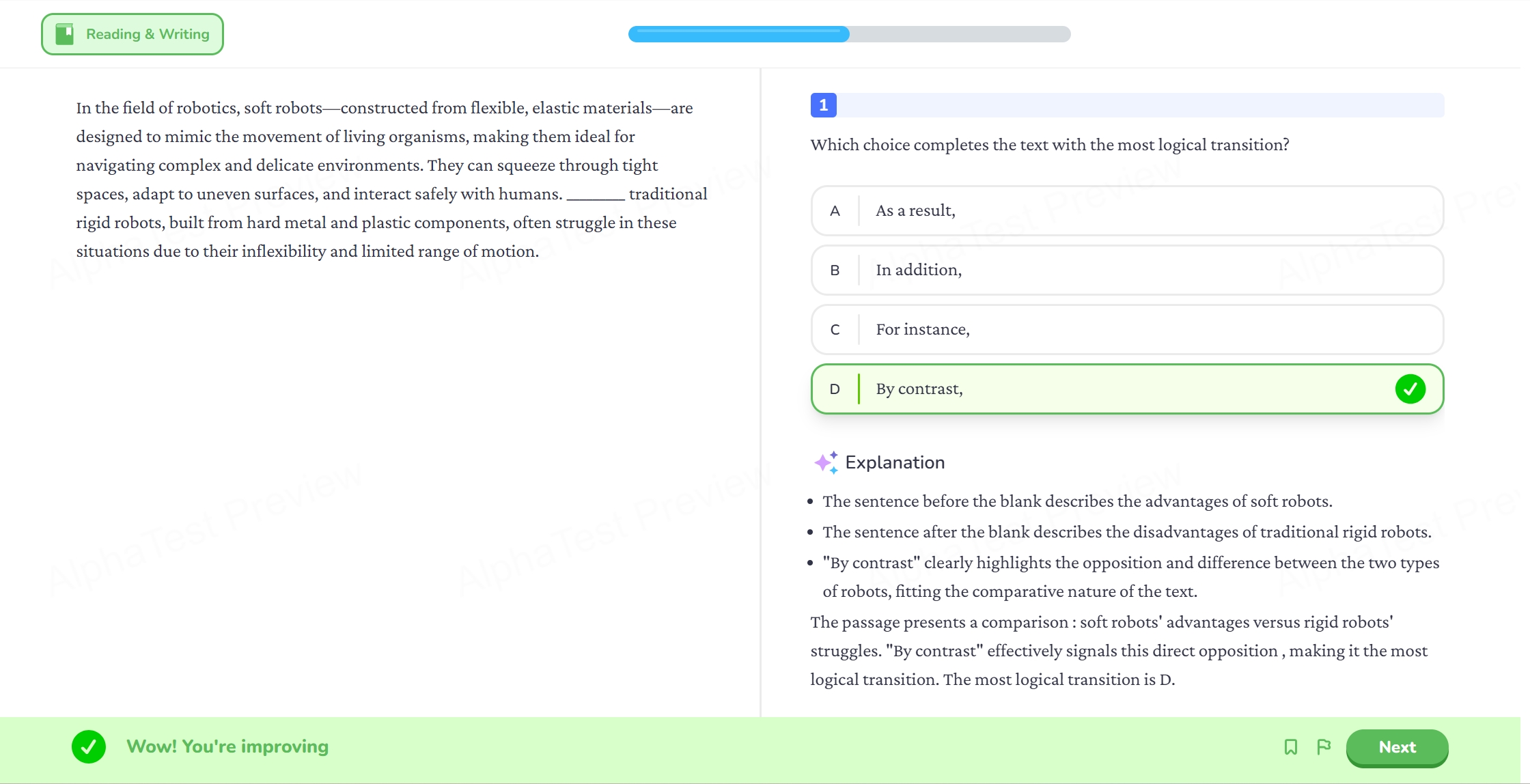
Correct Answer: D) By contrast
Jessica's Analysis: This is a textbook example of a "Binary Opposition" logic question—one of the most consistent patterns on the Digital SAT. Students most often hesitate on Option A (As a result), falling into what we call the "False Causality" trap.
Logic Clues:
- Subject Shift: The text before the blank focuses on Soft robots, utilizing keywords like "flexible," "ideal," and "adapt." These represent Positive (+) Attributes.
- Comparison Target: After the blank, the subject shifts to Traditional rigid robots, utilizing keywords like "hard metal," "struggle," and "limited." These represent Negative (-) Attributes.
- The Pivot: When the text jumps directly from the advantages of one entity to the disadvantages of an opposing entity, the logical relationship must be one of Contrast.
Vocabulary & Structural Precision:
- By contrast: This transition perfectly signals the opposition between the flexibility of soft robots and the stiffness of traditional ones.
- The "Result" Trap: Many students are tempted by A (As a result) because it feels smooth to read. However, you must check the logic: The success of soft robots is not the cause of the rigid robots' failure. Rigid robots struggle due to their own physical attributes ("inflexibility"), not because soft robots exist. Since there is no direct causal link, "As a result" is logically invalid.
Here is the analysis for this Standard English Conventions question, following the same "Jessica Lee" format.
The "Displaced Transition" Trap (Punctuation & Boundaries)
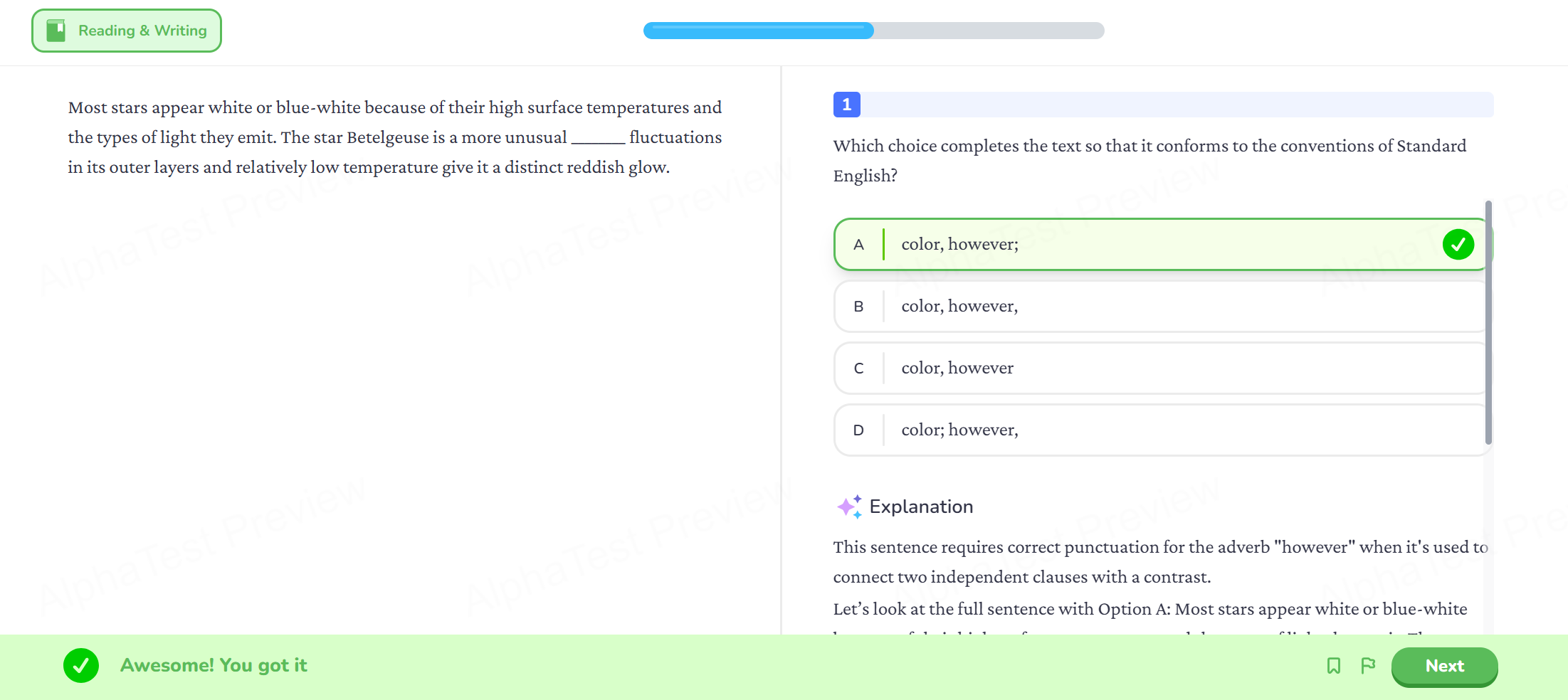
Correct Answer: A) color, however;
Jessica's Analysis: This is a sophisticated "Sentence Boundary" question that tests if you can identify where a transition word logically belongs. The College Board loves to use "However" in non-standard positions to trap students who are strictly looking for the ; however, pattern.
Grammar & Logic Breakdown:
- Identify the Clauses: Clause 1: "The star Betelgeuse is a more unusual color" (This is a complete thought). Clause 2: "Fluctuations in its outer layers... give it a distinct reddish glow" (This is also a complete thought/Independent Clause). The Connector: You need a strong punctuation mark (period or semicolon) to separate two independent clauses.
- Locate the Contrast: The previous sentence discusses "Most stars" (white/blue). This sentence discusses "Betelgeuse" (unusual color). Key Insight: The word "however" is functioning as a contrast between Most stars and Betelgeuse. Therefore, "however" grammatically belongs to the first clause. Read it like this: "The star Betelgeuse is a more unusual color, however." (Pause).
- The Trap (Option D): Option D (color; however,) is the most common wrong answer. If you choose D, you are attaching "however" to the second clause: "However, fluctuations... give it a distinct reddish glow." The Logic Fail: There is no contrast between having an "unusual color" and the "fluctuations that cause it." That is a cause-and-effect relationship. Therefore, you cannot use "however" to start the second part. "However" must stay with the first part to contrast with the previous sentence.
- [Independent Clause 1 + Transition], [Statement of Fact].
- Option A correctly closes the first thought (including the transition) with a semicolon, setting up the explanation in the second half.
The "Interrupter" Distraction (Subject-Verb Agreement)
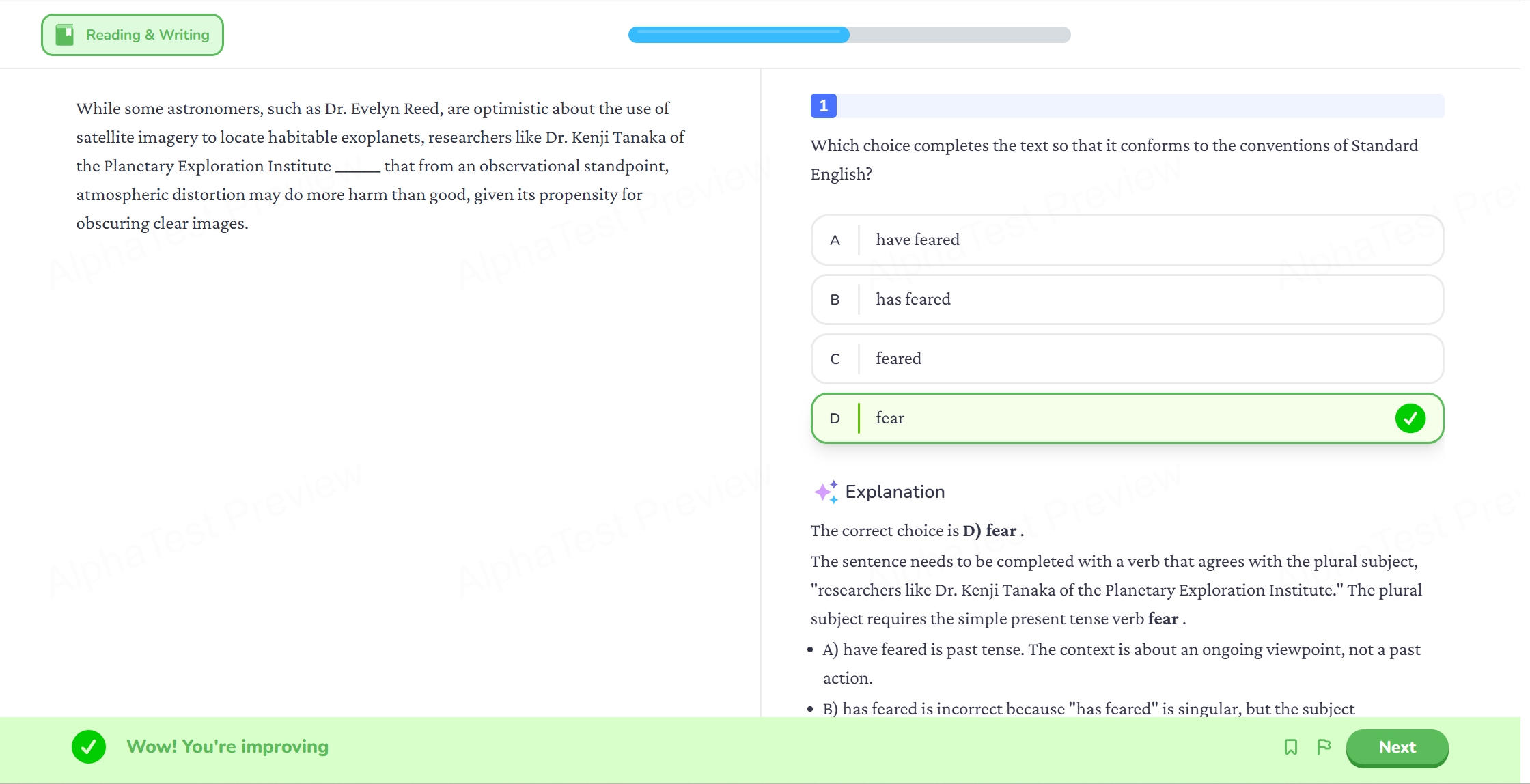
Correct Answer: D) fear
Jessica's Analysis: This is a classic Subject-Verb Agreement question designed to test whether you can be thrown off rhythm by a long modifier (an "Interrupter").
Logic Clues:
- Locate the Subject: The core subject of the sentence is "researchers" (Plural).
- Ignore the Noise: The phrase "like Dr. Kenji Tanaka of the Planetary Exploration Institute" is merely an interrupter (prepositional phrase) used to modify the researchers. Do not look at "Dr. Kenji Tanaka" or "Institute" (the nouns closest to the blank) and be tricked into picking a singular verb.
- Tense Consistency: The first half of the sentence uses "are optimistic" (Present Tense), indicating this is a general viewpoint or current state of affairs. Therefore, the second half should also maintain the Simple Present tense.
Trap Breakdown:
- Option B (has feared): This is the biggest trap. The test makers intentionally place singular nouns like "Institute" and "Dr. Tanaka" right before the blank to bait you into choosing the singular verb "has." Remember: The verb agrees with the Subject, not the nearest noun.
- Option A (have feared): Present Perfect ("have feared") usually implies an action that started in the past and continues into the present. However, since the context is discussing a general academic stance, Simple Present (fear) is the most concise and accurate choice.
Final Takeaway
The December SAT is a test of both psychology and precision. Remember, do not pursue speed in Module 1; accuracy is the only key to unlocking Hard Module 2. For high scorers, victory lies in the calm deconstruction of abstract logic questions in Module 2. Stay focused, trust the data, and your strategy will translate directly into points.
Next Step: Immediately audit the detailed report of your most recent practice test. Calculate your error rate in the "Information and Ideas" category. If it exceeds 15%, focus your final week on logical reasoning rather than language mechanics.

FAQ:
Q: Is Module 2 really that much harder than Module 1?
A: Yes, this is a designed "Difficulty Cliff." Based on the Digital SAT's adaptive logic, if you enter Hard Module 2, you will see almost no simple grammar or direct information retrieval questions. The section will be dense with abstract logical reasoning and complex syntax. Be mentally prepared—feeling "this is difficult" usually means you are in the high-score bracket.
Q: What should I do if I encounter unknown words (Vocabulary in Context)?
A: Do not fixate on the word itself. Use "Positive/Negative Charge." Determine if the context of the sentence is positive, negative, or neutral, and eliminate options with mismatched emotional alignment. Second, look for Clue Words (e.g., "and" implies continuity, "but" implies contrast) to deduce the missing word from known information.
Q: With only one week left, where is the highest ROI (Return on Investment)?
A: Standard English Conventions (Grammar) and Transitions. These two types of questions are strictly Rules-based, unlike reading comprehension which relies on intuition. High-intensity targeted practice can significantly improve accuracy in these areas within a short time, buying you the margin of error needed for harder reading questions.
Author Profile
Jessica Lee - Senior SAT Preparation Strategist
Ms. Jessica Lee is a Senior SAT Preparation Strategist at AlphaTest, focusing on standardized test strategies and score optimization. Leveraging years of teaching and data analysis of 750+ scorers, Jessica provides students with proactive, score-driven advice.